eunice.
ai due diligence and monitoring for digital assets. london, fca regulatory sandbox, $8m seed. i joined as an early product and research hire. this is the work.
london · fca regulatory sandbox · $8m seed
an ai product sold to regulated institutions has to prove it is right. i built the measurement, the frameworks and the scoring that let it.
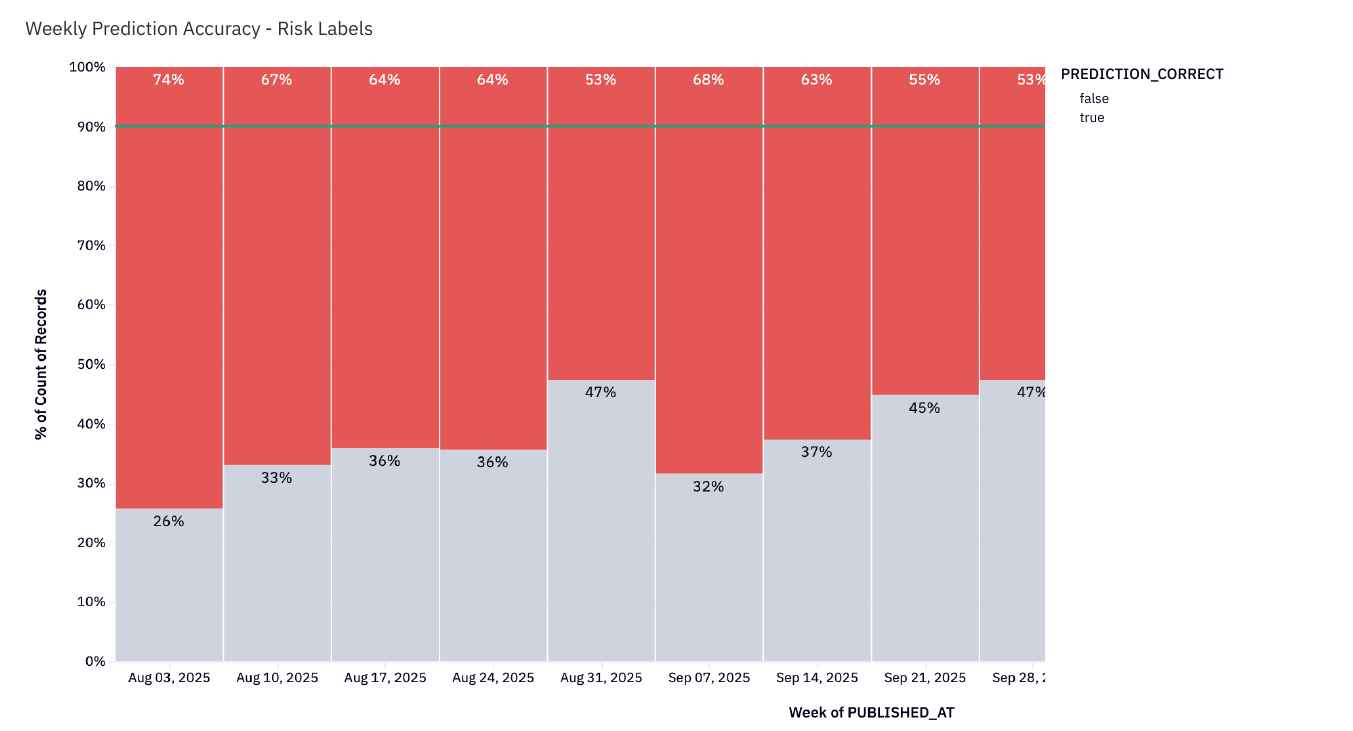
the daily evaluation loop, measured weekly
The work
evaluation & qa program
golden datasets, llm-judge scoring, daily human review. relevancy accuracy doubled.
due-diligence library
frameworks across defi, stablecoins, rwas and more. 60 to 100+ criteria each.
deterministic risk rating
seven domains, ~50 evidence-gated flags, one 0–100 score a regulator can re-derive.
financial-crime research
how the first line investigates, and how the second line tests it.
case 01 / 03
measuring when the model is wrong
the problem
eunice sold ai due-diligence answers to regulated institutions. no one could say how often those answers were right.
what i did
co-designed the evaluation program and ran it daily: golden datasets, llm-judge scoring calibrated against human review, per-category benchmarks against openai and perplexity.
outcome
event-relevancy accuracy doubled over the eval period. the internal benchmark finished ahead of both frontier baselines.
case 02 / 03
an expanded due-diligence library
the problem
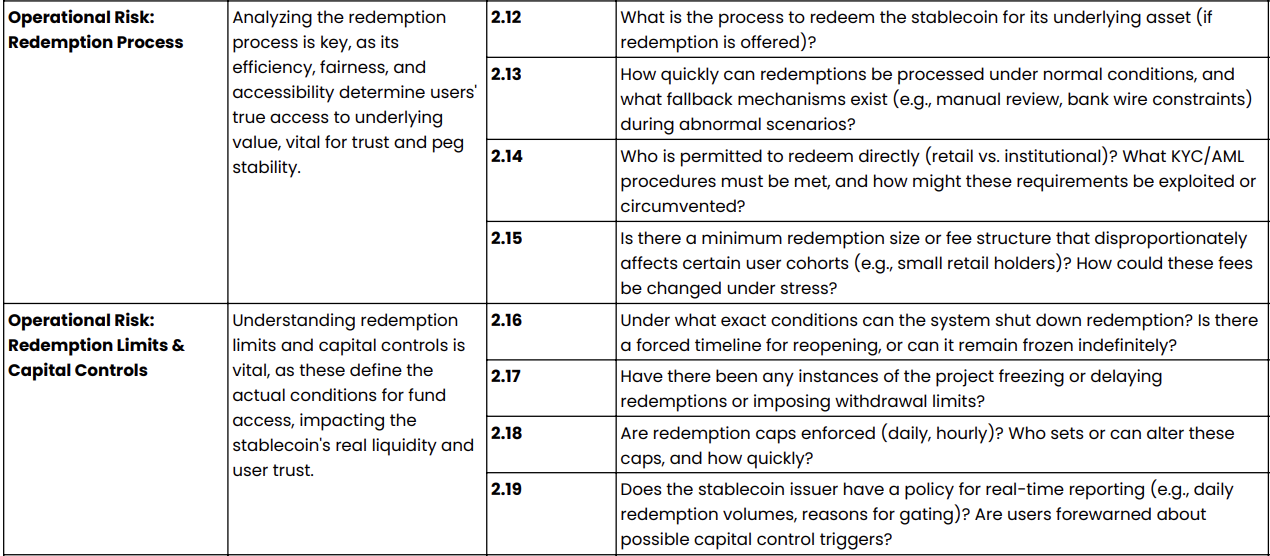
a stablecoin fails through its redemption process. a defi protocol fails through its oracles. one generic template covers neither.
what i did
expanded the dd template library across the asset classes institutions actually hold: defi, stablecoins, rwas, smart-contract platforms, ai/depin and more. 60 to 100+ criteria per framework. i owned assessment and testing, and each template ran against live tokens before release.
case 03 / 03
a risk score a regulator can re-derive
the problem
a regulated digital-asset custodian wanted a risk verdict it could defend to its regulator. a model scores the same project differently on two runs, so the model could not own the number.
what i did
the model finds and evidences flags. i wrote the deterministic rule set that converts them to a score: seven domains, ~50 binary evidence-gated flags, severity points, per-instance accumulation for repeat hacks, one 0–100 rating.
outcome
same flags in, same score out. in production with the custodian.
research
we built for compliance teams, so we studied how they work
two studies of financial-crime operations at regulated fund institutions: how the first line investigates, and how the second line tests it. institutions anonymised.
how the first line actually investigates
what fires an alert
the rule library is enumerable:
- threshold and velocity — one transaction above the tier limit, or cumulative flows inside a rolling window
- round-trip — subscription then redemption with no market rationale, the classic fund layering signature
- profile deviation — size, frequency, product or funding account inconsistent with what the investor declared
- third-party payments, and redemptions routed to a bank account added just before the instruction
- structuring — repeated amounts sitting just under review thresholds
- tokenised funds add three — screening hits on a wallet, p2p transfers inside the whitelist, a sudden switch of redemption rail
how the analyst works it
- clock first. can value leave before the review finishes? a wrong hold costs a client an hour, a wrong release is unrecoverable
- baseline next. the cdd file and history define normal for this investor. no baseline on file is itself the first finding
- evidence across eight types, from full transaction history to on-chain traces, with rfis framed as routine refresh so nothing tips the customer off
- race two stories. the crime typology and the innocent explanation, then name the evidence that separates them
- disposition in writing, against a named standard, inside an sla. suspicion that survives the innocent-explanation test goes to the mlro, and a second reviewer samples closed alerts to catch rubber-stamping before an examiner does
the worked case. a tokenised-fund investor receives tokens p2p from a whitelisted wallet that screening later links to a sanctioned cluster two hops out. trigger, evidence pack (kyc file, on-chain trace, transfer history, rfi to the administrator), freeze consideration, mlro pack with transaction hashes as exhibits.
how the second line keeps the number honest
the root document
everything traces to the business-wide risk assessment:
- inherent, controls, residual. risk scored across customers, products, channels and geography, mapped against the control library, leaving a residual the firm compares to its risk appetite
- built on numbers, not narrative — customer counts by tier, alert and str statistics, screening match rates, testing findings
- control effectiveness rated twice, design and operation, using live monitoring-and-testing results
- out of appetite means an action plan with an owner and a date. refreshed annually and on triggers: new product, new jurisdiction, new regulation, a material incident
overseeing what you don't control
where work is delegated to fund administrators, capability moves but accountability stays:
- re-perform, don't re-read. re-derive the rating, re-run the screen. a 25-file sample detects problems, it never proves absence
- sample where the delegate is thinnest, so testing complements their controls instead of duplicating them
- findings carry severity floors set before testing starts, and evidence-of-closure gets defined the day the finding is raised
- the escalation ladder ends in an exit that has actually been tested, or it isn't a ladder
- when the controls are code, failure is wholesale rather than file-by-file: test the spec, the behaviour and the change control, not just files
the worked case. a cash fund and a tokenised fund scored on the same grid. tokenisation raises inherent risk on the product axis (wallet custody, p2p transferability, instant stablecoin exit), and the whitelist and freeze controls pull residual back down, because in a tokenised fund the controls are embedded in the product itself.